Gold started the new trading week with something that immediately caught traders’ attention — a wide weekend gap of nearly 60 points.
On Friday, January 16, 2026, XAUUSD closed around 4596.61. When the market reopened after the weekend, price jumped straight to 4655.38, leaving a clear imbalance behind. During the Asian session, gold pushed even higher, printing a high near 4690.77, before settling around the 4670 zone as London stepped in.
To many traders, this looked like a clear bullish continuation.
To institutions, it looked like unfinished business.
In this article, we’ll break down:
- What this weekend gap really means
- Why higher-timeframe bias still matters
- How London typically behaves after such moves
- And what smart money is likely watching next
This isn’t about predicting price. It’s about understanding market behavior.
What a Weekend Gap Really Means in Gold
Weekend gaps in gold are not common — and when they happen, they matter.
A gap of this size usually forms because price repriced while the market was closed. That repricing could come from:
- Risk adjustments
- Geopolitical developments
- Institutional position imbalance
- Or anticipation of future liquidity needs
Here’s the key distinction many traders miss:
Retail traders often see gaps as confirmation.
Institutions see gaps as imbalances.
In gold especially, gaps larger than 40 points are rarely ignored. They tend to be:
- Partially mitigated the same day, or
- Fully addressed within one to three sessions
This doesn’t mean price must crash. It means the market often seeks efficiency before continuing.
Higher-Timeframe Context: Why Bias Still Matters
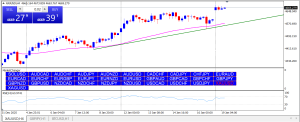
Despite the dramatic opening, the higher-timeframe structure remains bullish.
On the H4 chart:
- Price is trading above a rising mean
- Market structure remains intact
- Momentum is strong but not euphoric (RSI in the mid-60s)
- No confirmed bearish divergence is present yet
This tells us something important:
The gap did not break structure.
It simply stretched price away from value.
In institutional trading, bias answers one question only:
In which direction does the market prefer to resolve once inefficiencies are addressed?
Right now, the answer is still up — but timing matters.
The London Session: Where Most Traders Get Trapped
As London opened around 4677.94, price was still trading inside the Asian range.
This detail is critical.
London rarely exists to continue Asian impulse moves. Its primary role is often to:
- Test liquidity
- Challenge early positioning
- Correct short-term inefficiencies
When price opens deep into premium — especially after a weekend gap — London frequently becomes a retracement session, not a continuation one.
This is where many traders struggle:
- Buying because price “looks strong”
- Selling because price “feels overextended”
- Without understanding why price is behaving that way
Institutions don’t chase.
They wait for the market to rebalance.
The Gap Strategy: What Comes First, Then What Matters
Based on historical behavior and current structure, two scenarios stand out.
Scenario One: Gap Mitigation First (Higher Probability)
In this case, price gradually works lower to address the imbalance created at the open.
Key areas institutions may target:
- 4655 – the weekend gap open
- 4620–4600 – mid-gap and prior value zone
- 4596 – Friday’s close (full gap fill)
This doesn’t mean a bearish trend. It means cleaning up positioning before any sustained move higher.
Scenario Two: Immediate Continuation (Lower Probability)
For gold to ignore the gap:
- Price must hold firmly above 4695
- There must be strong bullish displacement
- No meaningful rejection from Asian highs
- Even in this scenario, delayed mitigation often appears later during New York or subsequent sessions.
Practical Takeaways for Traders
This type of market environment rewards patience, not aggression.
A few key reminders:
- Bias is not an entry
- Gaps are context, not signals
- London and New York often play different roles
- Chasing price after a weekend gap is usually late risk
- Professional traders focus on process, not excitement.
They let price reveal intent — session by session.
Final Thoughts
Gold remains structurally bullish on higher timeframes.
But this week’s wide weekend gap introduced a short-term imbalance that institutions rarely ignore.
Whether the gap fills today or later, the key is understanding why price moves — not reacting emotionally to where it is.
Smart money doesn’t rush.
It waits for the market to tell the truth.